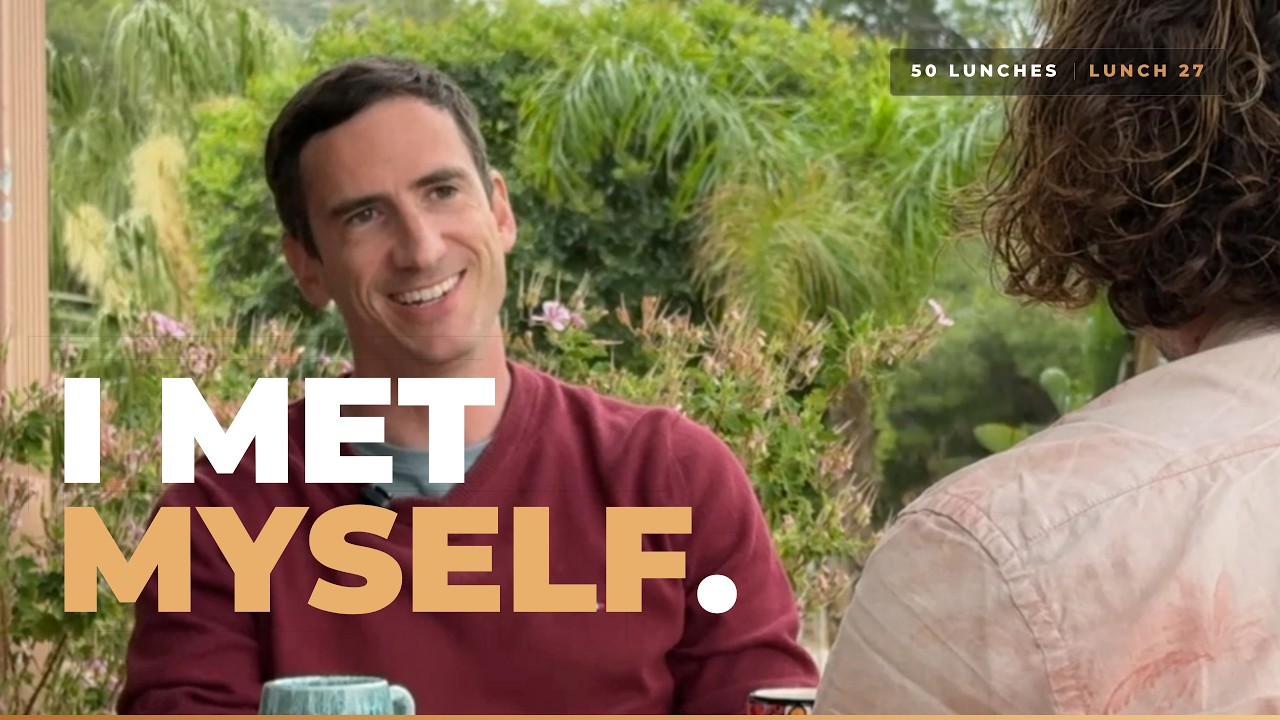
Mike and I worked together years ago at Ultimate Beauty, where he was the resident coach and I was the one trying to work out how to give a whole company what he was giving a handful of people. So this was not a cold interview. It was two friends picking up a thread. What I did not expect was how far back the thread went.
Mike has meditated for something like 27,000 hours. About five of those years were a closed retreat in the south of France, twelve hours a day, no going in or out. He went in at 23 and came out at 28. You would think a person like that walks into a room glowing with answers. Instead he said something I did not expect. He came out feeling like a beginner.
Trying to win a meditation retreat
The best part of his story is the part that went wrong. Mike is American, and he walked into that retreat the way a lot of us walk into anything that matters. He was going to win it. Track the hours, set the targets, do more, push harder. And at some point he broke. Hit rock bottom. He asked himself what he was actually building, and the honest answer was a bigger ego in a nicer outfit.
What changed was the direction. He stopped trying to construct a better version of himself and started taking things off instead. In his words, it is not that he built something up, it is more that he stripped things away. I think about that a lot, because the people I coach are almost all high achievers, and the instinct is always to add. More effort, more systems, more tracking. Mike's whole life is an argument that past a certain point, the move is to subtract.
Everything you believe was built, so you can rebuild it
The most useful idea in the conversation is also the simplest. A belief is not a fact. It is something your mind built out of experience, repeated until it felt solid. A dog bit you, or you heard about it, or you saw it in a film, and now "dogs are dangerous" feels like the truth. Mike's point is that because a belief was built from experience, you can rebuild it the same way, by deliberately stacking up experiences that fit the belief you would rather hold.
The catch is that your mind fights back. It throws up emotions and excuses to keep you acting in line with what you already believe, because that feels safe. Seeing the mechanism is half the work. Once you can watch it happen, the belief stops feeling like reality and starts feeling like a setting you can change.
Even purpose is a stack of beliefs
We ended where the whole conversation started, on purpose. As a teenager, Mike used to get drunk and ask strangers what the point of life was. Decades later his answer is that purpose is not a thing you find, buried somewhere inside you. It is a set of beliefs about what matters, mostly handed to you by where you were born and who raised you. Which sounds bleak until you notice the freedom in it. If purpose is built, you can choose it.
His own is refreshingly small. Benefit as many people as he can before he dies, starting with the one mind he has the most access to, his own, and the three people who copy everything he does, his kids. He put it more bluntly than that. Try to be less of a dick. Be less frustrated when they will not put their shoes on.
What I took away
Two things. First, if you are good at achieving and you feel stuck anyway, the answer might not be to try harder. It might be to take something off. Second, the beliefs that feel most like facts are the ones worth checking, because they were built, and anything built can be rebuilt.